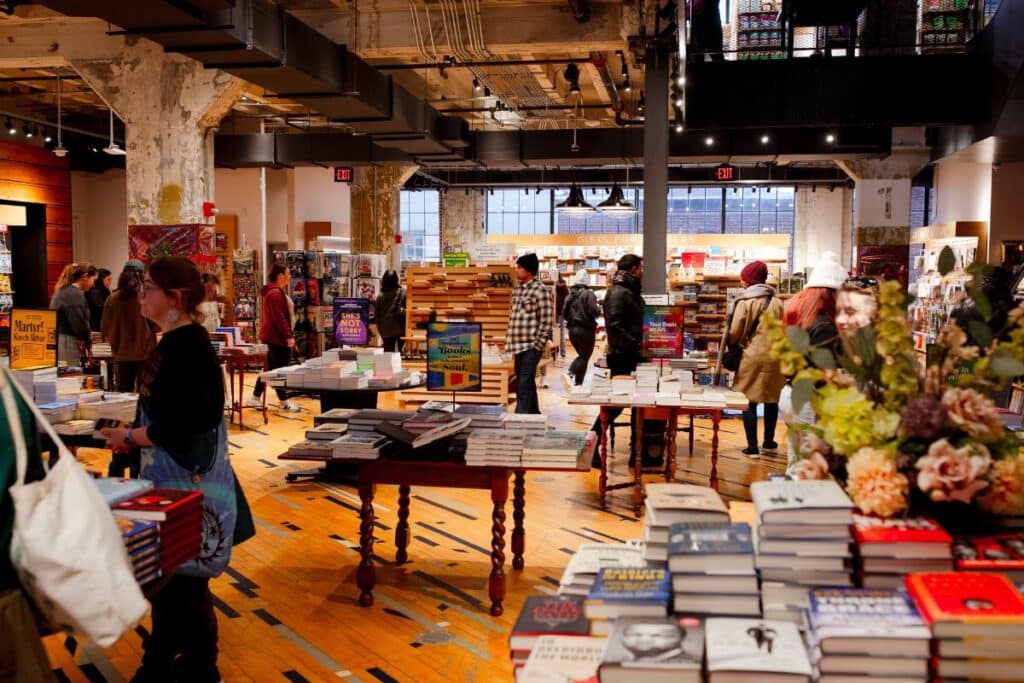
Barnes & Noble says it’s in the midst of tremendous growth, crediting its turnaround to a strategy built on something surprisingly old-fashioned–letting booksellers be booksellers.
After more than 15 years of declining store numbers, the company reports strong sales and the fastest expansion in its modern history. In 2024, it opened more new bookstores in a single year than it had during the entire decade from 2009 to 2019. And the growth didn’t stop there: more than 60 stores opened in 2025, with another 60 already slated for 2026.
The turnaround rests on a strategic shift away from heavy corporate control. Instead of uniform, identical layouts and centralized buying decisions, local booksellers now shape their own shelves—choosing titles based on the tastes of the community in front of them. Displays are hand-curated. Staff picks matter again. One store may spotlight literary fiction and campus favorites; another may lean toward romance, fantasy, and regional history.
The chain’s identity has changed with it. New stores are smaller, more intimate, and more neighborhood‑focused than expected big-box retailers. “We’ve completely reversed that rulebook,” CEO James Daunt said. “When you walk into a store, you’re not quite sure what you’re going to find and what it’s going to be priced at.” The goal is simple: beauty, curation, and a browsing experience led by the community who actually read and booksellers who know their readers.
And readers are responding. The company says momentum from 2025 is carrying into the new year, with foot traffic and sales rising across markets. Many of the 2026 openings—across states like Ohio, Texas, Florida, Illinois, California—reflect a renewed interest in in-person discovery, something online shopping can’t replicate. Some cities, like San Antonio, are even slated for multiple new stores.
Zoom out, and the timing makes sense. Independent bookstores have also seen growth in recent years, signaling a cultural shift toward physical spaces where reading is shared, recommended, and experienced.
Readers are craving curation again—the kind of personalized, face-to-face discovery that algorithms can’t replicate. And rather than competing directly with those independents, Barnes & Noble’s new model increasingly mirrors them: smaller stores, local autonomy, relevant novelty products, and more books.
A Turnaround Story Rooted in Book Culture
The line between chain and indie has blurred in a way that would have been unthinkable a decade ago. It’s book culture, and it gives readers something they haven’t had in years: variety.
That’s why this moment matters. A national bookseller thriving alongside independent shops suggests something bigger is happening. It’s not a fight for survival, but a resurgence of brick-and-mortar reading culture itself.
For a company once seen as a symbol of big‑box homogenization, the reinvention is striking. After years of decline, Barnes & Noble isn’t just stabilizing; it’s expanding with confidence, betting that a national chain can thrive by thinking locally. If the numbers from 2025 are any indication, the 2026 rollout won’t be a nostalgic attempt to revive the past. It’s a new version of the brand—leaner, more flexible, and unexpectedly successful—taking shape in real time.

Thalia Mercer is a writer covering mystery and thriller fiction, with a focus on book-to-screen adaptations and contemporary reading culture. She writes about why certain stories resonate—and how they translate beyond the page.