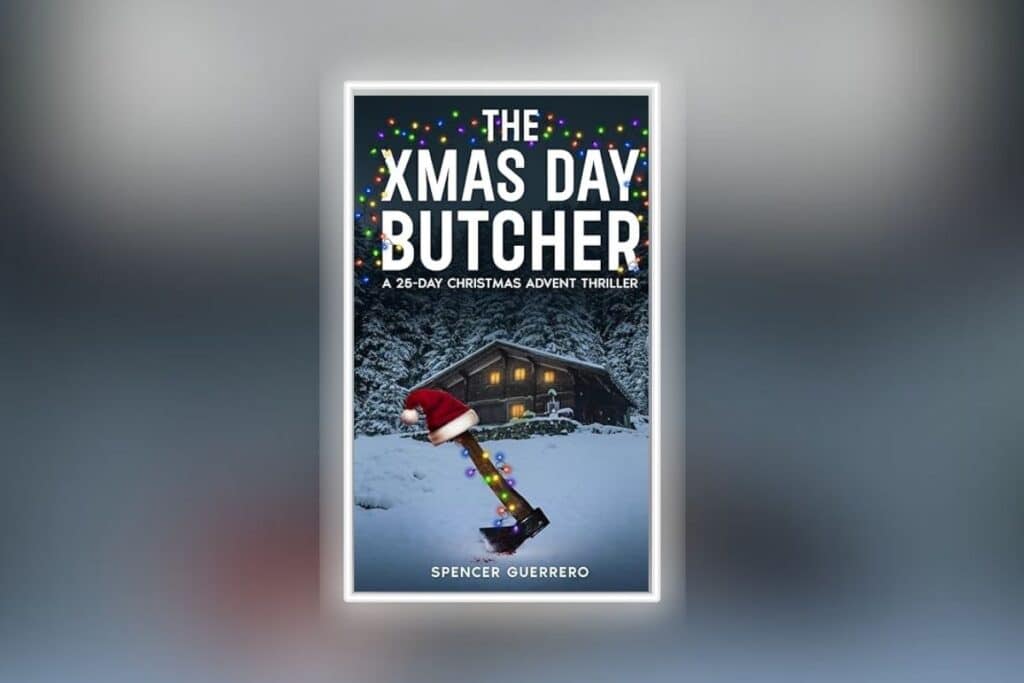

Merry Christmas. It’s 5 a.m. My son is still asleep. The day hasn’t started yet—but it’s December 25, and I’ve just finished The XMas Day Butcher, a 25-day advent read that ends precisely when it should on Christmas Day. It delivered exactly the kind of sharp, seasonal tension I look for this time of year. A tension Spencer Guerrero establishes immediately.
Lenny Frost’s wife disappears at the start of the Christmas season, and what begins as a search quickly turns into something far more controlled and sinister. A serial killer known as the Xmas Day Butcher forces Lenny into a countdown—an advent-style sequence of clues, discoveries, and escalating violence—each day bringing him closer to the truth and closer to Christmas Day itself. Set in a small, snowbound town full of quiet alliances and buried histories, the novel unfolds less like an investigation and more like a psychological endurance test.
This isn’t a slow burn. There’s little excess description and no indulgent atmosphere-building. The narrative stays in motion with each chapter bringing another discovery, another destabilizing realization, another pull toward the truth. The pacing feels deliberate, almost relentless, to keep you coming back every day (or finishing in a single setting).
Rather than relying on procedural logic, the novel moves through relational pressure points. It’s the connections—who knows whom, who trusts whom, who is hiding what—that ultimately drive the story forward. The result is a mystery that feels intimate and emotionally charged rather than clinical.
Lenny himself is a deeply psychological narrator. Told in first‑person past tense, the story filters through his fragmented perspective—marked by blackouts, missing time, and blurred certainty. We’re locked into his experience but never fully grounded in it. The past‑tense framing quietly amplifies the tension: because Lenny is recounting events after they’ve already occurred, every detail feels selected, withheld, or distorted. Small omissions matter. Casual phrasing carries weight. Even ordinary moments feel haunted by the sense that something has already gone wrong.
That restraint is occasionally frustrating—certain emotional beats feel intentionally underdeveloped—but it’s thematically aligned with a story obsessed with hidden selves and suppressed truths.
Finished on Christmas Day, The XMas Day Butcher feels well‑suited for seasonal reading without leaning too hard on holiday tropes. The gifts, the cold, the ticking calendar—they add texture without overwhelming the story, making it an effective Christmas‑set thriller. It’s unsettling, occasionally graphic, but never gratuitous. The violence serves the psychology, not the spectacle.
At its core, the novel circles a quietly disturbing idea: the most dangerous monsters aren’t always strangers, and they don’t always announce themselves. That theme lingers long after the final page.
The Ending Explained (Spoilers included)
Click here for spoilers.
If the main review explores the novel’s tension, the ending reframes its entire architecture. The revelation that Lenny’s brother is still alive feels subtly foreshadowed, but Angela’s final act is the true destabilizer. Her role forces a reexamination of who the story has been about all along.
Rather than positioning Angela as a sudden villain, the novel suggests something more unsettling: that violence, once modeled and normalized, can be transmitted. Just as Lenny’s brother was shaped—conditioned—into a killer, Angela appears to have absorbed the same logic. Whether that conditioning was intentional manipulation or a latent capacity waiting to surface is left deliberately ambiguous.
The novel resists offering a clean moral hierarchy between predator and victim. Instead, it implies that proximity to violence leaves a residue—that monsters are not only born, but learned. By the time Angela acts, the question is no longer why she kills, but whether she ever truly had a chance not to.
The final twist doesn’t resolve the story so much as complete its thesis: the monster was never singular. It was systemic, relational, and quietly passed along.
Who This Book Is Best For
The XMas Day Butcher will appeal most to readers who favor momentum over ornamentation. The prose is intentionally direct, the chapters tight, and the structure built for propulsion. Readers who enjoy character‑driven psychological thrillers, unreliable narrators, and countdown narratives will find plenty to appreciate.
Those expecting lush description, deep procedural detail, or extensive exploration of the protagonist’s past may feel the book’s restraint more sharply. Reactions to the novel often split along those lines: some readers respond strongly to its brevity and urgency; others find its simplicity limiting. That divide feels less like a flaw than a reflection of taste—and of how intentionally narrow the book’s focus is.
Content warnings from the author: death, murder, abduction, depiction of severe mental illness, severed human limbs, and graphic scenes of violence.
About Spencer Guerrero
Spencer Guerrero is the best-selling author of the XMas Day Butcher. He is a screenwriter and novelist who has written over a dozen short stories and twenty screenplays. His work is most prominently seen in young adult, mystery, fantasy, and literary fiction.

Thalia Mercer is a writer covering mystery and thriller fiction, with a focus on book-to-screen adaptations and contemporary reading culture. She writes about why certain stories resonate—and how they translate beyond the page.